
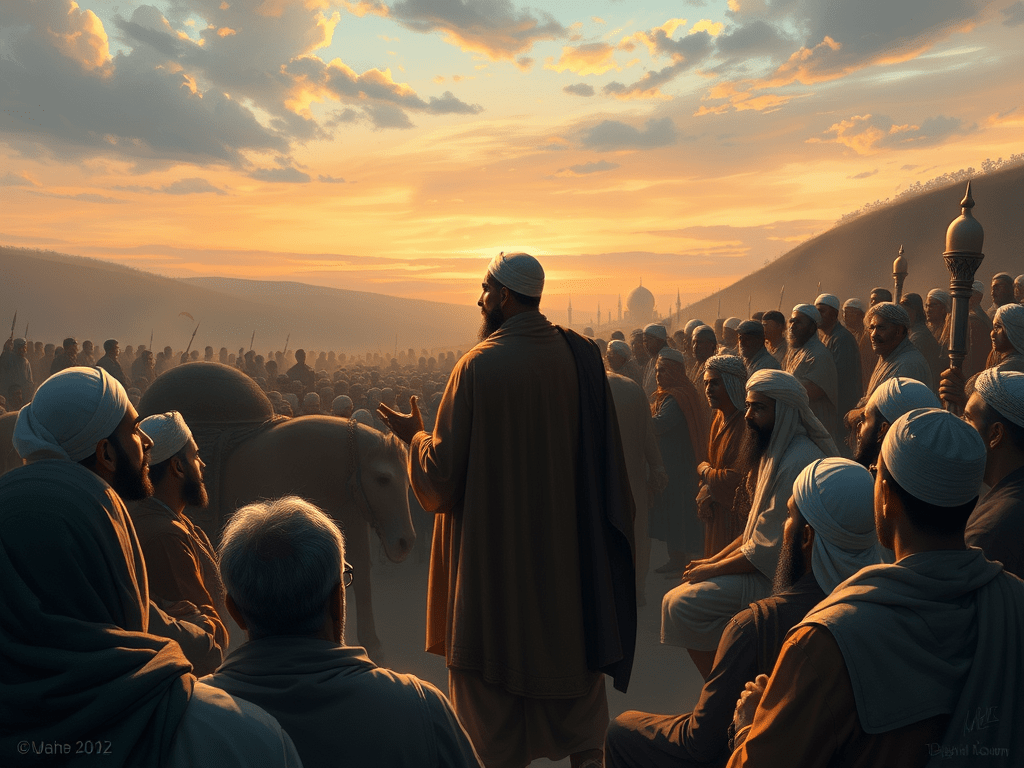
The importance of Ghadīr Khumm for ‘Alī is highlighted by ‘Alī himself on the Day of Raḥba because he was demanding the Muslims to testify for the validity of the Sermon of Ghadīr. (Musnad Ahmad b. Hanbal)
It is important to remember that ‘Alī could have simply mentioned the famous sermon by himself without asking for witnesses and everyone should have accepted it since he is the authoritative, political ruler, but no, ‘Alī assured that the people testify, so this important event is actually recognised, fathomed and recorded properly.
The question arises, if the Sermon of Ghadīr is not indicative of absolute authority, then why would ‘Alī’ mention this incident that occurred years ago and then bring witnesses to substantiate his claim during the time of political turmoil? If this sermon was merely confined to support and alliance and not about spiritual authority, then ‘Alī should have also brought up this Prophetic sermon during his previous disputes with the first three Caliphs, similar to the way he emphasised it on the Day of Raḥba.
If ‘Alī’s Wilayat was confined to alliance and support, he should have told Abī Bakr and Omar that the believers (including them) are obliged to support his cause concerning Caliphate and that the land of Fadak belonged to them (Ahlulbayt) as well. Yet, he didn’t because he couldn’t. If the Imam did this after the Caliphs established their power, then the consequences would have been harmful for ‘Ali’s family and the believers who supported him due to the true inference and implication of the Sermon of Ghadīr and that is why he only used the Prophetic sermon during his own governance.
Accordingly, ‘Alī reminded the people of the Sermon of Ghadīr in Kūfa because many of the people have abandoned and neglected the verdict of the Prophet and this verdict was essential to law and order because the sermon pertains to ‘Alī’s Divine authority, which is intrinsically linked to the guidance of the community. Some neglected the matter of ‘Alī’s right intentionally, some subsided it due to circumstances and some disregarded it due to ignorance.
Through the gained testimonies, ‘Alī assured that this vital information is acknowledged by all because evidently, many of the Sahaba passed away and many newcomers were unaware of this vital information. It is as if ‘Alī was asserting that after many years have passed, he finally achieved political authority, yet his legitimacy and authority was ordained and established not by the people, not by the support, but by the will of God and His Messenger from the very beginning.
By Abul Hasan al-Gabikani al-Shadi al-Shaddadi al-Hadhabani -al-Kurdi
Reference: Islamic political Thought: The Imamate Doctrine between the Zaydi and Imami schools,, P.59
Painting by Hassan Ruholamin
 Tajdeed
Leave a comment